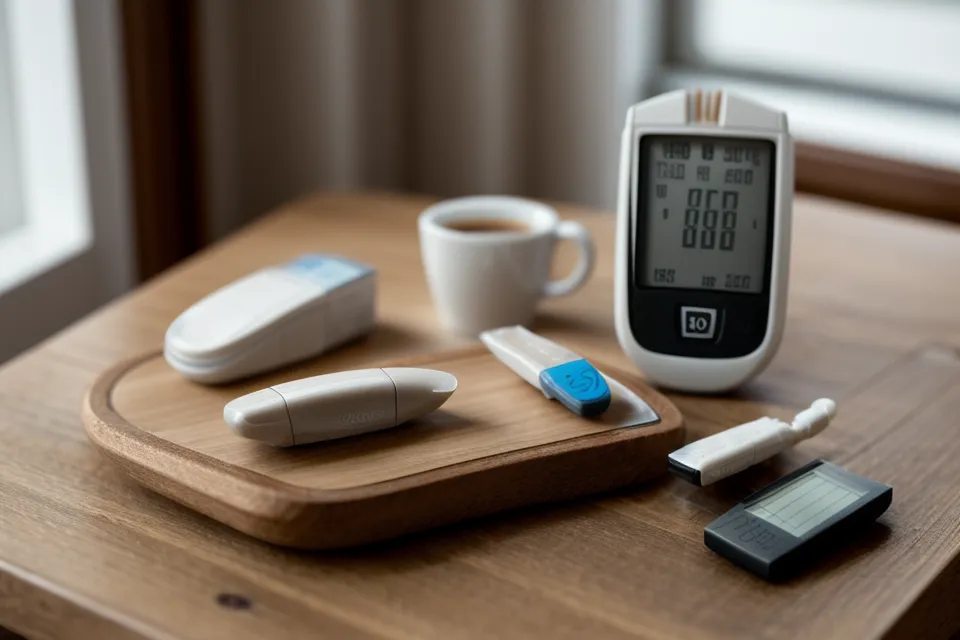
The lancet is loaded and the cap is half off bottle number three when I stop and set both down. My notebook column for fasting readings looks like a seismograph, and I can't tell which bottle deserves the credit or the blame. That's the kind of morning that taught me the rule behind all my glucose tracking now: one variable at a time, with a clean washout period between each supplement test. For any man over 50 working on prediabetes management with a meter and a crowded shelf, that gap matters more than any single product. Here's the exact design I use, step by step.
Quick background: I'm not a doctor, a nutritionist, or any kind of health professional. I run a small business in suburban Atlanta, and since a routine physical sent me home with an A1C of 5.8%—just over the prediabetes line—my kitchen counter has been a makeshift lab. My wife calls it my second business (she's not wrong). I track the numbers, test the variables, and measure my ROI (Return on Insulin, as I jokingly call it) in a spreadsheet that gets more care than my quarterly taxes. Yes, I'm that guy.
Overlapping Supplements Wreck a Baseline
Back when I started, I ran my health like a marketing department. If a campaign stalls after a few days, tweak it. If a supplier runs late, swap them out. I brought that speed-to-market habit to my mornings, adding a second bottle and then a third before the first had a fair trial. Four different "natural supports" were riding along every day.
The trouble is that a fasting number is one output with many possible inputs. Overlap the inputs and you can't assign credit. The meter flashed 128 one morning after a quiet, sensible evening, and I had four suspects with no way to rank them. It felt like changing my pricing, my product line, and my staff in the same month, then wondering why sales dipped.
Slow signals make it worse. A1C moves on a schedule set by the average red blood cell lifespan, so nobody expects it to react in days, yet I expected my meter to sort out four overlapping bottles in that same short window. Even a strict keto month, where I changed just one thing, taught me something: my fasting numbers barely moved once the first stretch passed. That was a disappointing result, but it was a readable one, and a flat line I can read beats a jagged one I can't.
What Does a Washout Period Look Like?
A washout period is a stretch where none of the test items are in play, so the log shows my baseline instead of a blend of leftover experiments. Think of it as a physical inventory count before you place a new order. You can't judge what a new product added until you know what's already on the shelf.
Clearing the counter comes first. On a normal stretch, my supplement shelf works like a queue, with the bottle under test at one end and the next candidates lined up behind it. For a washout, that shelf goes bare and every bottle moves out of sight. Only my ordinary daily multivitamin stays, since it was part of my routine before any testing began. Anything my doctor prescribed stays exactly as prescribed—that's not mine to adjust.
Length comes next, and I don't negotiate with myself about it. Mine is ten days with nothing but the multivitamin. The first days felt exposed, like running the shop without insurance. I don't call the washout finished by the calendar alone, though. I call it finished when my fasting readings stop swinging wildly from one morning to the next. Mine had been bouncing between 95 and 130, and once the swings stopped I finally had a clean ledger. It wasn't a miracle, since the readings were still in prediabetic territory, but it was a baseline I could trust.
My sheet eventually showed a five-day fasting average of 103, my best stretch to date, and the only change I'd made was to stop adding things. I touched on the bigger picture in my morning routine shift and why I stopped obsessing over fasting glucose alone, but the washout gave that idea a much cleaner starting line.
Glucose Tracking Habits That Keep the Washout Clean
During a washout I log less, but I log it tighter. The spiral notebook keeps its ruled columns for fasting and post-meal readings, and I add a plain-English note for anything unusual: a short night, a stressful client call, a hard session at the LA Fitness on Peachtree Industrial in Dunwoody, a drink the night before. Sleep, stress, morning coffee, water intake, and alcohol each get a tick mark because any of them can muddy a reading on their own, and each deserves its own write-up rather than a rushed paragraph here.
The meter kit stays parked next to the coffee maker so the morning routine never changes: same kit, same spot, same order of steps. Think of it as quality control. If my method shifts between readings, I can't tell a real change from a sloppy one, and a washout can't do its job on sloppy data.
Dose Timing and the Dawn Phenomenon
Even with an empty shelf, my highest readings landed right after waking, hours after my last bite. That's the dawn phenomenon, an early-morning pattern I'll leave to the post on fasting baselines.
What it changed for me was dose timing. I'd been taking supplements with dinner and judging them by the next morning's reading, a gap of many hours that I couldn't vouch for. I couldn't say whether an evening capsule and a morning number were even connected, so I was grading a supplement on evidence I hadn't earned. Now every dose gets a clock time in the notebook next to the reading time, and I compare like with like across days.
The full counter routine behind all of this is laid out in my kitchen counter experiment and how I track numbers after a surprise result, if you want the mechanics of the daily logging.
Set a Seven-Day Gate Before Each New Bottle
Now I keep a strict rule: no new bottle gets opened without seven days of clean baseline data first. Clean means the mornings look like a flat road, and any bump has a note in the notebook to explain it. If a couple of mornings jump for no reason I can name, the gate stays shut and I keep collecting.
Every new supplement gets treated like a new hire on probation. I want to see what it does on its own, without three other consultants whispering in its ear, so only one item changes at a time. A single cycle takes longer this way, sometimes a long while, but the data is finally something I'd hand to my accountant.
A friend who coaches youth soccer on Saturday mornings once asked why I wouldn't just try the new bottle right away. My answer was that starting one without a baseline is like hiring three people in the same week and then asking which one closed the sale.
Being the guy who brings his own food to a neighborhood barbecue is annoying enough. Being that guy with no idea whether the routine works is just bad business.
When a Number Goes Bad, Check the Log First
If a fasting number makes you want to throw your meter out the window, take a breath before reaching for anything new. Open the notebook first and check the dose timing, a short night, a rough day, and whether the baseline was clean. The answer, more often than I expected, is sitting in the ledger and not in the bottle.
One caution: a washout applies to supplements you chose to add, never to anything a doctor prescribed. I'm not a health professional, and stopping or starting anything that matters is a conversation for your own doctor, who is also the right person to ask about your targets. What I can offer is a method. Empty the shelf, hold a baseline, add one item, and let the log do the talking.
It's less exciting than a miracle pill. But a spreadsheet that tells the truth is worth more to me than one that tells a good story.
This site documents one person's experience and should not be treated as expert advice. Your circumstances are unique — please consult a qualified professional before making any decisions about your health or finances.