
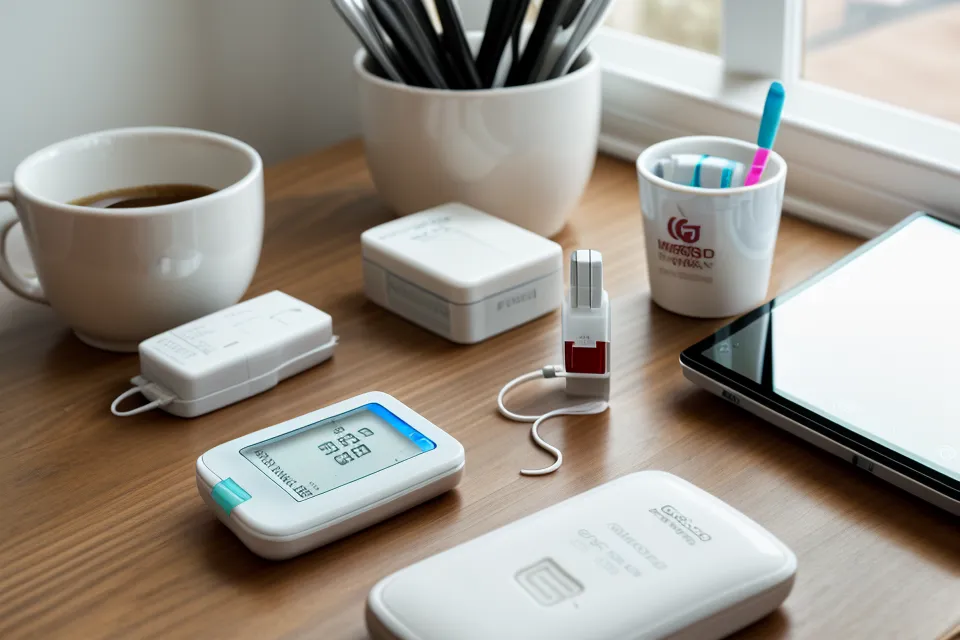
The lancet pen clicks against my finger before the coffee's even finished dripping, and the meter's backlit screen is the only light on in the kitchen. A small blue glow in a room that's otherwise still asleep. I've done this most mornings for two years now, waiting out a five-second countdown like it's a stock ticker. Glucose monitoring turned into my version of a prediabetes journey nobody warns you about: equal parts spreadsheet hobby and blood sugar support experiment, run out of a kitchen counter in Cobb County instead of a doctor's office. This particular stretch of supplement testing was all about Gluco6, and ten weeks in, the ledger finally had something worth reporting.
Quick disclosure before the numbers: I get a small commission if you buy through a link on this page, at no extra cost to you, and I only write about supplements I've actually bought and tracked against my own meter. None of this is medical advice — I'm not a doctor or a dietitian, just a guy who turned his kitchen counter into an unofficial lab, so run anything you try past your own doctor first.
The A1C Number That Started My Glucose Monitoring Habit
My doctor's office called it a routine physical, which felt like false advertising once the nurse printed out my results. The number that mattered was my A1C, and mine landed just over the line into prediabetic territory. I won't turn this into a lecture on what that percentage actually measures; that's a rabbit hole for a different post. But it was enough to send me home with a vague "watch your sugar" and no actual plan.
Running a small business for most of my adult life means I don't love unmonitored numbers, whatever they're attached to. An expense line creeping upward gets investigated the same week, not the same year, so treating my own glucose like some annual checkbox felt backwards. A drugstore meter and a cheap box of lancets later, I had my first real baseline, and it was higher than I wanted to admit out loud.
I Gave Gluco6 an Honest Ten Weeks
Before Gluco6 ever showed up on the counter, I'd already spent six weeks on cinnamon capsules a stranger recommended in a Reddit thread, and my fasting numbers never moved an inch. That was my first lesson in treating supplement claims like unverified vendor promises — nice packaging, no proof until I ran my own numbers. So when I decided to commit to Gluco6, I gave myself a full ten-week test window instead of bailing after the first disappointing week.
What pulled me toward it over the usual cinnamon-heavy formulas was the ingredient list — it pairs something called sukre with chromium instead of leaning on cinnamon alone. Two capsules a day, a glass of water, done before the coffee finished brewing. The spreadsheet picked up a new column, right next to the shelf where I keep whatever supplement I'm currently testing lined up in the order I'm running through them.
Weeks one and two looked like nothing — fasting numbers drifting in a tight, unimpressive band, which in business terms is the part where you're paying for inventory that hasn't sold yet. I kept logging it all into a spreadsheet that now has more tabs than my actual invoicing software, which says something uncomfortable about my priorities. By week six the band had narrowed further, and by week ten the pattern held steady enough that I stopped bracing myself before the meter finished counting down.
One Barbecue's Limited Impact on Ten Weeks of Tracking
Short answer: almost, but not quite. A cookout at the food plaza by Truist Park in The Battery turned into the kind of plate I used to eat before any of this started, and I didn't think twice about seconds. Nobody has ever accused me of pacing myself at a buffet.
The next morning's fasting reading came in noticeably higher than anything I'd logged in weeks, and old-me would have panicked and doubled up on capsules to compensate. New-me just logged it, shrugged, and moved on, because overcorrecting after one bad night is how you turn a blip into a worse week. If you're in that panicked spot after a spike, I'd point you toward how to lower blood sugar fast when your fasting numbers spike before you do anything drastic.
Watching a Friend Bet Everything on Kombucha
A friend of mine ferments his own kombucha in the garage, jars lined up like a tiny chemistry set, and swears it's the reason his energy holds steady through the afternoon. I believe him, mostly, though I've never once seen him put a meter near his finger to check. We go back and forth about it over coffee — his fermentation log against my glucose log, both of us convinced our method is the disciplined one.
Portability is where the comparison actually gets interesting. His kombucha needs babysitting — temperature, timing, an airlock he checks twice a day — while a two-capsule dose like Gluco6 travels in a jacket pocket without complaint. Not every approach needs to be elaborate to be worth tracking; sometimes the boring, portable option wins on logistics alone, even before you get to results.
Capsules Versus Drops
Curiosity about delivery format eventually got the better of me, so I cross-referenced my Gluco6 notes against Sugar Defender, which runs on liquid drops instead of capsules. Same general goal, noticeably different mechanics.
Handling-wise, a capsule wins on simplicity — swallow it with water and move on, no dropper to measure during a rushed morning, where liquid drops can get sticky if you're hurrying out the door. On ingredients, Gluco6 stays narrow and targeted, built mostly around sukre and chromium, while the liquid format tends to pack in a wider spread of plant extracts in one bottle. And on the trial window, Gluco6's 60-day money-back guarantee runs shorter than Sugar Defender's 180-day window, which matters if you're the type who wants a long runway before committing either way — current terms are always worth checking straight from the vendor page since promotions shift.
Neither format won outright in my notebook — one edges out on convenience, the other on ingredient variety, and your daily routine probably decides it faster than any review can. For the full mechanics of how each one played out on my meter, liquid drops or daily capsules covers it in more detail than I can fit here.
What My Notebook Showed by Autumn
By the time autumn rolled around, the ledger told a cleaner story than I expected. The tight, elevated band from the spring had given way to steadier mornings, and the afternoon fog that used to flatten me after lunch had mostly lifted. One morning around week ten I logged my number at eight and realized, almost as an afterthought, that I hadn't made a single break-room vending machine run all week — my spreadsheet had quietly tracked a habit shift before I'd consciously noticed it myself.
None of this replaces an honest look at your own daily habits, and no bottle on that shelf is doing the work alone. If you're shopping for anything in this category, what to look for in blood sugar supplements before you buy online is worth reading before you commit a cent, because label transparency matters more than whatever claim is printed on the front. Gluco6 earned a steady spot in my routine, but the real ROI came from finally watching the numbers instead of guessing at them — which, if I'm running this like the business I keep comparing it to, is the only metric that was ever going to matter.
This site documents one person's experience and should not be treated as expert advice. Your circumstances are unique — please consult a qualified professional before making any decisions about your health or finances.