Somewhere around the fourth bottle on my kitchen counter, I stopped trying to keep berberine and bitter melon straight in my head and just built myself a cheat sheet — the same way I'd build a vendor comparison sheet for the business, except the vendors here are plant extracts instead of anything I actually know how to price out.
I'll say up front I'm not a scientist. I'm a guy who went in for a routine physical, walked out with an A1C just past the prediabetic line, and has been logging fasting glucose in a color-coded spreadsheet ever since (my wife calls it my second business, and she's not wrong). Every ingredient below got the same treatment I'd give a vendor invoice — check what's actually being delivered against what was promised, and flag anything that doesn't add up. A few things here didn't hold up once I went back to the actual studies instead of trusting the label copy, so I fixed them instead of quietly leaving them wrong.
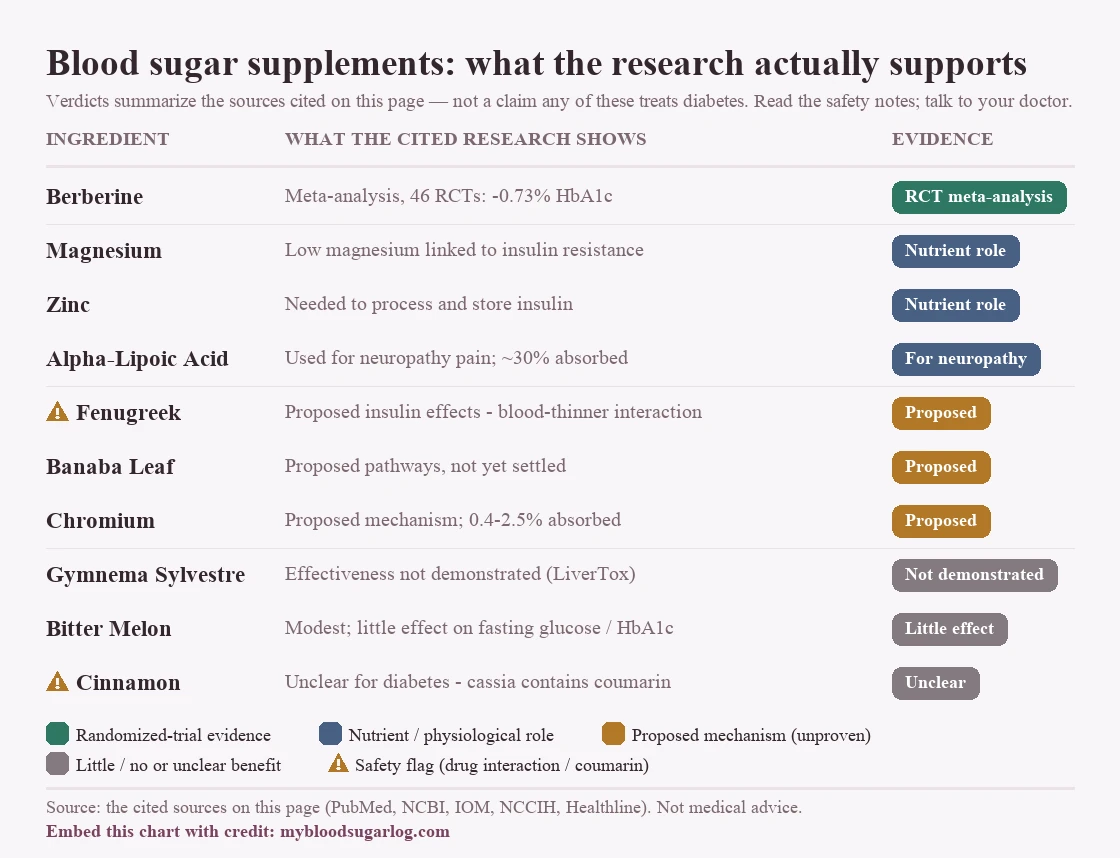
The honest bottom line: of these ten ingredients, only berberine has randomized-trial evidence of actually lowering HbA1c — and even that effect is modest (about −0.73 percentage points). Everything else is mechanism, deficiency-correction, or "maybe." None of them replace your medication or a conversation with your doctor.
Core Ingredient Reference Table
Here's the rundown on ten ingredients that keep showing up across the bottles I've tested and the ones I never bothered to open. The middle column is the part that actually matters — what the cited research says happened, not what the front of the bottle implies happened.
| Ingredient | Primary Active Compound(s) | What the Cited Research Reports | Typical Commercial Form |
|---|---|---|---|
| Berberine | Berberine Alkaloid | Regulates AMPK/mTOR and related signaling pathways; also shown to modulate gut microbiome composition (Source). | Sold as berberine HCl |
| Gymnema Sylvestre | Gymnemic Acids | Inhibits sweet-taste receptors; may enhance insulin secretion and reduce glucose absorption. LiverTox notes overall effectiveness for diabetes treatment has not been demonstrated (Source). | Sold as concentrated leaf extract |
| Banaba Leaf | Corosolic Acid | Proposed mechanisms include enhanced cellular glucose uptake and decreased gluconeogenesis — the review frames these as multiple possible pathways, not one settled mechanism (Source). | Sold as standardized corosolic-acid extract |
| Alpha-Lipoic Acid | ALA / DHLA | Mitochondrial cofactor for pyruvate dehydrogenase; used for diabetic-neuropathy pain, though oral bioavailability is only about 30% (Source). | R-ALA (natural) or S-ALA (synthetic) |
| Bitter Melon | Charantin, Polypeptide-p | LiverTox states the exact hypoglycemic mechanism is not known; placebo-controlled trials show only a modest effect on blood sugar, with little or no effect on fasting glucose or HbA1c (Source). | Sold as concentrated fruit extract |
| Fenugreek | Galactomannan, 4-OH Ile | Proposed to stimulate insulin release, improve insulin signaling, suppress glucagon, and delay gastric emptying (Source). Also carries a documented interaction risk with blood thinners (warfarin, antiplatelet drugs) at high doses (Source). | Sold as ground seed powder or fiber-rich extract |
| Chromium | Chromium(III) Ion | May amplify insulin receptor tyrosine kinase activity in response to insulin — a proposed mechanism, not an established effect. Dietary absorption of chromium(III) is estimated at 0.4% to 2.5% (Source). | Picolinate or polynicotinate forms |
| Magnesium | Magnesium Ion | Required cofactor for over 300 enzyme systems (Source); reduced intracellular magnesium is linked to impaired insulin action and worsening insulin resistance in people with type 2 diabetes (Source). | Citrate, glycinate, or oxide forms |
| Cinnamon | Cinnamaldehyde | Per NCCIH, it's unclear whether cinnamon as a dietary supplement helps people with diabetes; it may help increase insulin sensitivity in general, though more research is needed (Source). | Whole ground bark or water-soluble extract |
| Zinc | Zinc Ion | Zinc ions are essential for the normal processing and storage of insulin; variants in the zinc-transporter gene SLC30A8 (ZnT8) affect Type 2 Diabetes risk (Source). | Gluconate, picolinate, or citrate forms |
Comparison of Cinnamon Varieties
Cinnamon was the one that burned me early. I ran a bottle of plain grocery-store cinnamon capsules for about six weeks, logging my fasting number every morning, and nothing moved that I could pin on the capsules — which sent me down a rabbit hole on why "cinnamon" on a label doesn't tell you much by itself. Turns out there are two very different plants hiding under that one word, and the difference matters more than the price tag suggests:
- Cassia Cinnamon (Cinnamomum cassia): The "regular" cinnamon sold in most grocery stores. Contains approximately 1% coumarin by weight, a compound that may be hepatotoxic in large, sustained quantities (Source).
- Ceylon Cinnamon (Cinnamomum verum): Known as "true" cinnamon. Contains only about 0.004% coumarin — roughly 250 times less than cassia — which is why it's the variety more often recommended for daily, long-term supplementation (Source).
As for whether either one actually does anything for blood sugar specifically — the honest answer, straight from that same source, is that it's unclear whether cinnamon as a supplement helps people with diabetes, though it may nudge insulin sensitivity in a general way (Source). Which tracks with my own six weeks of capsules doing nothing I could measure.
Mineral Roles in Glycemic Control
Minerals are the ingredients I underestimated the longest — no flashy "proprietary blend" branding, just plain nutrients that were already showing up in my bloodwork before any bottle got involved. Here's what the research actually backs up, ranges left in instead of rounded off to something cleaner-sounding:
- Magnesium Deficiency: One review found hypomagnesemia occurring in 13.5% to 47.7% of people with type 2 diabetes, depending on the study population — a wide enough range that I stopped trusting any single number a bottle quotes for this (Source).
- Chromium Absorption: Chromium picolinate is the most studied form for glucose metabolism, but dietary chromium(III) is absorbed at an estimated 0.4% to 2.5% (Source) — low enough that "how much is in the pill" and "how much your body actually uses" are two very different numbers.
- Berberine Efficacy: A meta-analysis pooling 46 randomized controlled trials found berberine reduced HbA1c by an average of 0.73 percentage points versus control (95% CI -0.97 to -0.51) — a real, statistically significant effect, though a more modest one than most marketing copy implies (Source).
Last verified: 2026-07-11
One more thing before the source list, because it matters more than any ingredient above: I'm not a doctor, a pharmacist, or a nutritionist — just a small business owner with a glucose meter and too many supplement bottles on his counter. Nothing on this page is medical advice, and it doesn't replace an actual conversation with your own doctor or pharmacist, especially before combining any of this with medication you're already taking. Fenugreek is the one I'd flag hardest here — it carries a documented risk of interacting with blood thinners like warfarin and antiplatelet drugs, particularly at higher doses, and that's not something you want to find out the hard way (Source).
This page is based on personal testing and published research, organized for informational purposes only — it is not a substitute for professional medical, financial, or legal advice. Talk to a qualified doctor or pharmacist before changing anything about your own routine, especially if you're already managing blood sugar with medication.
Sources
- PubMed: Multiple Target and Regulatory Pathways of Berberine (Zhou et al., 2025)
- PubMed: Berberine Effect on Metabolic Profiles in Type 2 Diabetic Patients — Meta-Analysis (Guo et al., 2021)
- NCBI Bookshelf: LiverTox — Gymnema
- PubMed: Management of Diabetes and Its Complications with Banaba and Corosolic Acid (Miura et al., 2012)
- PubMed: Insights on the Use of Alpha-Lipoic Acid for Therapeutic Purposes (Salehi et al., 2019)
- NCBI Bookshelf: LiverTox — Bitter Melon
- PMC: The Role of Fenugreek in the Management of Type 2 Diabetes (Haxhiraj et al., 2024)
- NCBI Bookshelf: LiverTox — Fenugreek
- NCBI Bookshelf: Institute of Medicine — Dietary Reference Intakes, Chromium
- NCBI Bookshelf: Institute of Medicine — Dietary Reference Intakes, Magnesium
- PubMed: Magnesium and Type 2 Diabetes (Barbagallo & Dominguez, 2015)
- PubMed: Hypomagnesemia in Patients with Type 2 Diabetes (Pham et al., 2007)
- Healthline: Ceylon vs. Cassia Cinnamon — What's the Difference?
- PubMed: Zinc and Diabetes (Chabosseau & Rutter, 2016)